Automating String Decoding in Malware: Analysing StealC V1 with IDAPython
Reverse engineering malware often feels like solving a puzzle where half the pieces are hidden. Among the most common obstacles analysts face is string obfuscation—a technique where malware authors encrypt or encode strings to evade detection and frustrate analysis. This anti-analysis technique appears in virtually every modern malware family, turning what should be straightforward analysis into hours of tedious manual work.
In this post, RevEng.AI will explore two approaches to dealing with this form of obfuscation. Firstly, we will demonstrate how to build an IDAPython script that automatically decodes obfuscated strings and renames associated variables using StealC V1 (the predecessor to StealC V2) as our case study. Second, we will showcase how RevEng.AI can expedite this process to dramatically accelerate reverse engineering workflows, freeing up analysts to focus on understanding the malware's actual behaviour. The sample analysed can be accessed here.
The Case for Automation
Before diving into the technical details, let's understand why automating string decoding is crucial for efficient malware analysis:
- Time Efficiency: Each obfuscated string requires multiple manual steps: identifying the decoding logic, extracting arguments, and performing the decoding. When dealing with hundreds of strings, this becomes prohibitively time-consuming.
- Accuracy: Manual analysis is prone to human error. It's easy to miscalculate offsets, incorrectly extract values, or make transcription mistakes that lead to incorrect conclusions about the malware's functionality.
- Pattern Recognition: Most malware families use a single decoding function throughout their codebase. Once you've identified the pattern, automation can apply it consistently across the entire binary.
- Focus on What Matters: By automating routine tasks, analysts can dedicate their cognitive resources to understanding the malware's core functionality, network behavior, and potential impact.
Understanding StealC V1's Obfuscation
When analysing the sample, the following function came across as being of particular interest. It takes a large number of encoded strings and passes them into the function at 0x45c0. We can see the decompiled output of 0x45c0 using the RevEng.AI AI Decompiler below:
/*
The function stealc_decodeString performs a XOR encryption on a given input string using a key.
It allocates memory for the encrypted string, performs the XOR operation character by character, and null-terminates the result.
Finally, it calls 0002ac70 with the encrypted string.
The function returns a pointer to the newly allocated and XORed string.
*/
char *
stealc_decodeString(
   const char *inputString,
   const char *key,
   size_t inputLength
)
{
   0002ac46("The Opus Theatre was founded by British-Argentine composer and concert pianist Polo Piatti and officially opened on 7 July 2017 in Hastings, in the United Kingdom.");
   0002ac46("The Opus Theatre was founded by British-Argentine composer and concert pianist Polo Piatti and officially opened on 7 July 2017 in Hastings, in the United Kingdom.");
   0002ac46("The Opus Theatre was founded by British-Argentine composer and concert pianist Polo Piatti and officially opened on 7 July 2017 in Hastings, in the United Kingdom.");
   0002ac46("The Opus Theatre was founded by British-Argentine composer and concert pianist Polo Piatti and officially opened on 7 July 2017 in Hastings, in the United Kingdom.");
   0002ac46("The Opus Theatre was founded by British-Argentine composer and concert pianist Polo Piatti and officially opened on 7 July 2017 in Hastings, in the United Kingdom.");
   char *outputString = (char *) 0002ac52(0002ac5e(), inputLength + 1);
   0002ac46("The Opus Theatre was founded by British-Argentine composer and concert pianist Polo Piatti and officially opened on 7 July 2017 in Hastings, in the United Kingdom.");
   0002ac46("The Opus Theatre was founded by British-Argentine composer and concert pianist Polo Piatti and officially opened on 7 July 2017 in Hastings, in the United Kingdom.");
   0002ac46("The Opus Theatre was founded by British-Argentine composer and concert pianist Polo Piatti and officially opened on 7 July 2017 in Hastings, in the United Kingdom.");
   0002ac46("The Opus Theatre was founded by British-Argentine composer and concert pianist Polo Piatti and officially opened on 7 July 2017 in Hastings, in the United Kingdom.");
   0002ac46("The Opus Theatre was founded by British-Argentine composer and concert pianist Polo Piatti and officially opened on 7 July 2017 in Hastings, in the United Kingdom.");
   outputString[inputLength] = 0;
   0002ac46("The Opus Theatre was founded by British-Argentine composer and concert pianist Polo Piatti and officially opened on 7 July 2017 in Hastings, in the United Kingdom.");
   0002ac46("The Opus Theatre was founded by British-Argentine composer and concert pianist Polo Piatti and officially opened on 7 July 2017 in Hastings, in the United Kingdom.");
   0002ac46("The Opus Theatre was founded by British-Argentine composer and concert pianist Polo Piatti and officially opened on 7 July 2017 in Hastings, in the United Kingdom.");
   0002ac46("The Opus Theatre was founded by British-Argentine composer and concert pianist Polo Piatti and officially opened on 7 July 2017 in Hastings, in the United Kingdom.");
   0002ac46("The Opus Theatre was founded by British-Argentine composer and concert pianist Polo Piatti and officially opened on 7 July 2017 in Hastings, in the United Kingdom.");
   for (size_t i = 0; i < inputLength; i++) {
       0002ac46("The Opus Theatre was founded by British-Argentine composer and concert pianist Polo Piatti and officially opened on 7 July 2017 in Hastings, in the United Kingdom.");
       0002ac46("The Opus Theatre was founded by British-Argentine composer and concert pianist Polo Piatti and officially opened on 7 July 2017 in Hastings, in the United Kingdom.");
       0002ac46("The Opus Theatre was founded by British-Argentine composer and concert pianist Polo Piatti and officially opened on 7 July 2017 in Hastings, in the United Kingdom.");
       0002ac46("The Opus Theatre was founded by British-Argentine composer and concert pianist Polo Piatti and officially opened on 7 July 2017 in Hastings, in the United Kingdom.");
       0002ac46("The Opus Theatre was founded by British-Argentine composer and concert pianist Polo Piatti and officially opened on 7 July 2017 in Hastings, in the United Kingdom.");
       outputString[i] = inputString[i] ^ key[i % 0002abb8(key)];
       0002ac46("The Opus Theatre was founded by British-Argentine composer and concert pianist Polo Piatti and officially opened on 7 July 2017 in Hastings, in the United Kingdom.");
       0002ac46("The Opus Theatre was founded by British-Argentine composer and concert pianist Polo Piatti and officially opened on 7 July 2017 in Hastings, in the United Kingdom.");
       0002ac46("The Opus Theatre was founded by British-Argentine composer and concert pianist Polo Piatti and officially opened on 7 July 2017 in Hastings, in the United Kingdom.");
       0002ac46("The Opus Theatre was founded by British-Argentine composer and concert pianist Polo Piatti and officially opened on 7 July 2017 in Hastings, in the United Kingdom.");
       0002ac46("The Opus Theatre was founded by British-Argentine composer and concert pianist Polo Piatti and officially opened on 7 July 2017 in Hastings, in the United Kingdom.");
   }
   0002ac46("The Opus Theatre was founded by British-Argentine composer and concert pianist Polo Piatti and officially opened on 7 July 2017 in Hastings, in the United Kingdom.");
   0002ac46("The Opus Theatre was founded by British-Argentine composer and concert pianist Polo Piatti and officially opened on 7 July 2017 in Hastings, in the United Kingdom.");
   0002ac46("The Opus Theatre was founded by British-Argentine composer and concert pianist Polo Piatti and officially opened on 7 July 2017 in Hastings, in the United Kingdom.");
   0002ac46("The Opus Theatre was founded by British-Argentine composer and concert pianist Polo Piatti and officially opened on 7 July 2017 in Hastings, in the United Kingdom.");
   0002ac46("The Opus Theatre was founded by British-Argentine composer and concert pianist Polo Piatti and officially opened on 7 July 2017 in Hastings, in the United Kingdom.");
   int seed = 0;
   0002ac70(outputString, sizeof(seed), 256, &seed);
   return outputString;
}
From this, we can see that StealC V1 employs a straightforward XOR-based string obfuscation technique. The decoding routine is elegantly simple, accepting three parameters via the stack:
- Key buffer - The XOR key used for decryption
- Encrypted buffer - The obfuscated string data
- Length - The size of the string to decode
The C implementation resembles:
char* decodeString(char* key, char* data, int size) {
    for (int i = 0; i < size; i++) {
        data[i] ^= key[i % size];
    }

    return data;
}
While the algorithm is basic, manually decoding hundreds of strings using this method would be exhausting.
Building the IDAPython Automation Script
Let's break down our automation approach into four logical components:
1. Locating All Decoder Calls
First, we need to find every location where the decodeString function is called:
def find_calls(ea_func):
    calls = []
    for ref in idautils.CodeRefsTo(ea_func, 0):
        if idc.print_insn_mnem(ref) == "call":
            calls.append(ref)
    return calls
This function leverages IDA's cross-reference capabilities to identify every call instruction targeting our decoder function, giving us a comprehensive list of decoding sites.
2. Extracting Stack Arguments
Before each call to decodeString, the malware pushes three arguments onto the stack. We need to backtrack from the call instruction to collect these values:
def get_info(ea):
    for _ in range(4):
        ea = idc.prev_head(ea)
        if idc.print_insn_mnem(ea).startswith("push"):
            # Extract and store the operand
            ...
Additionally, we track where the return value is stored after the call:
ea = initial_ea
for _ in range(2):
    ea = idc.next_head(ea)
    if idc.print_insn_mnem(ea) == "mov" and idc.print_operand(ea, 1) == "eax":
        # This is our target variable for renaming
        ...
3. Implementing the Decoder
With the extracted parameters, we can reimplement the XOR decoding logic in Python:
def decodeString(val1, val2, size):
    decoded_string = []
    for i in range(size):
        decoded_char = val2[i % size] ^ val1[i]
        decoded_string.append(decoded_char)
    return "".join(chr(i) for i in decoded_string)
To ensure variable names remain valid in IDA, we sanitize the decoded strings using regular expressions, removing any non-alphanumeric characters that could cause issues.
4. Automated Variable Renaming
The final step renames variables in the Hex-Rays decompiler view to reflect their decoded values:
# Create a descriptive name from the decoded string
new_name = f"str_{decoded_string[:247]}"

# Attempt to rename, handling potential collisions
success = idc.set_name(infos["var"], new_name, idc.SN_NOWARN)
When name collisions occur (multiple variables decoding to the same string), we append a counter to maintain uniqueness while preserving the meaningful connection to the decoded content.
Results and Impact
Running this script on a StealC V1 sample transforms the analysis experience:
- Immediate Context: Variables like
var_4Cbecomestr_kernel32_dll, instantly revealing their purpose - Revealed Infrastructure: Command and control servers, file paths, and registry keys become visible
- Behavioral Insights: API names and system commands expose the malware's capabilities
- Time Savings: Hours of manual work compressed into seconds of automated processing
RevEng.AI Community
RevEng.AI users analysing variants of StealC can now benefit from our internal analysis by matching pre-reverse engineered symbol data between the malware variants. To do so, simply match all functions using a RevEng.AI plugin for your SRE tool and set the filter to limit to the sample above. Alternatively, use our Web UI and then export a PDB or ELF debug file. Doing so will match functions using BinNet AI between the samples and merge any debug information.
Conclusion
Automating string decoding transforms malware analysis from a tedious manual process into an efficient, scalable workflow.
Automation frees us to focus on that narrative rather than getting lost in the mechanics of decoding. By investing time in building automation scripts, we not only accelerate individual analyses but create reusable tools that benefit future investigations.
Detection
YARA Rule
rule RevEng_StealC_1
{
    meta:
        author = "lloyd@reveng.ai"
        source = "RevEng"
        description = "Identifies both StealC V1 and V2 samples"
        version = "1.0"

        category = "MALWARE"
        malware = "STEALC"
        malware_type = "STEALER"

    strings:
        $v1_0 = "app_bound_encrypted_key"
        $v1_1 = "%08lX-%04hX-%04hX-%02hhX%02hhX-%02hhX%02hhX%02hhX%02hhX%02hhX%02hhX"
        $v1_2 = "\\Google\\Chrome\\User Data\\Local State"
        $v1_3 = "\\\\.\\pipe\\"
        $v1_4 = "0123456789abcdef"

        // NOTE: https://github.com/RussianPanda95/Yara-Rules/blob/main/StealC/win_mal_StealC_v2.yar
        $v2_0 = {48 8d ?? ?? ?? ??  00 48 8d}
        $v2_1 = {0F B7 C8 81 E9 19 04 00 00 74 14 83 E9 09 74 0F 83 E9 01 74 0A 83 E9 1C 74 05 83 F9 04 75 08}

    condition:
        uint16(0) == 0x5A4D and (all of ($v1_*)) or (all of ($v2_*))
}
YARAI
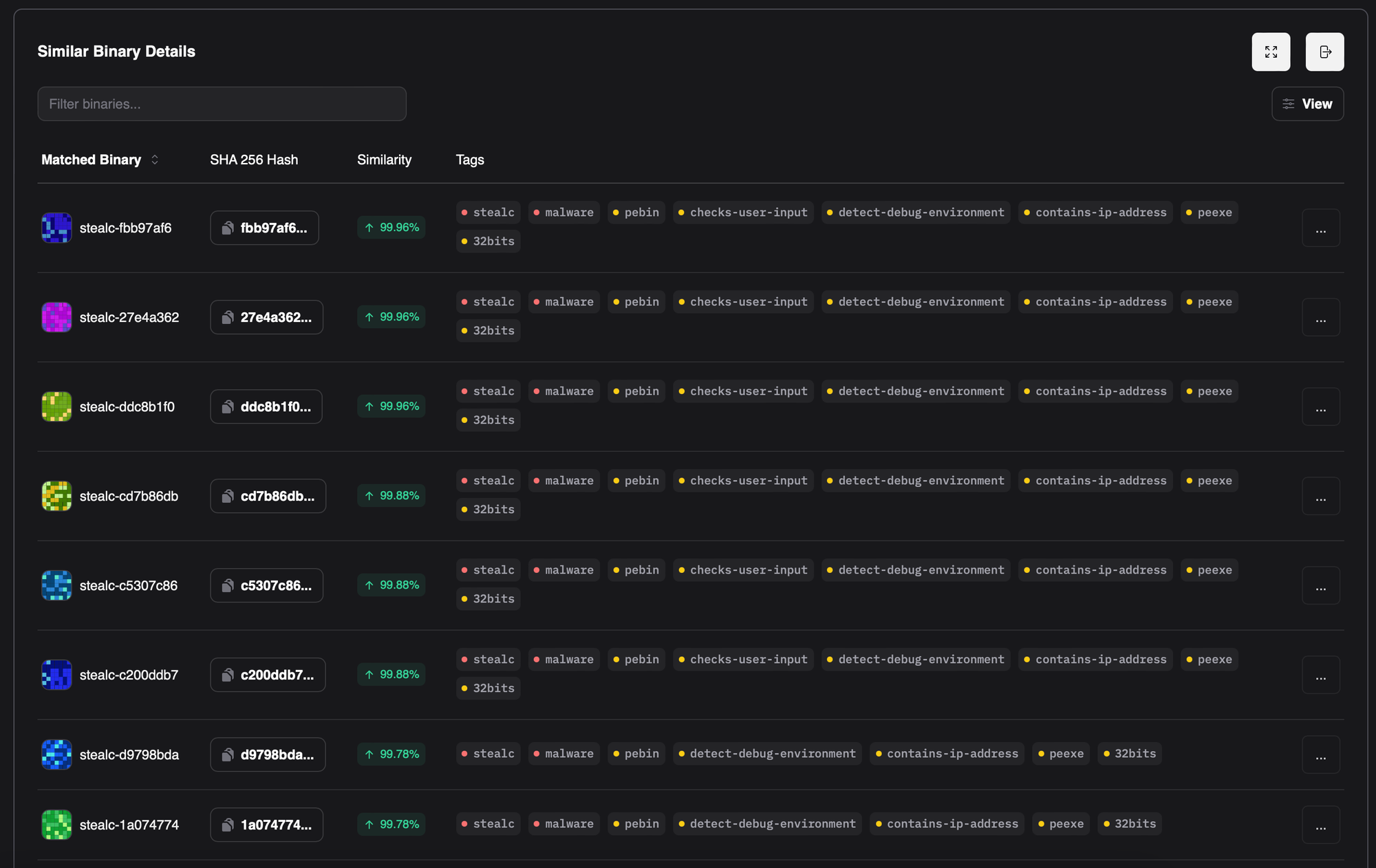
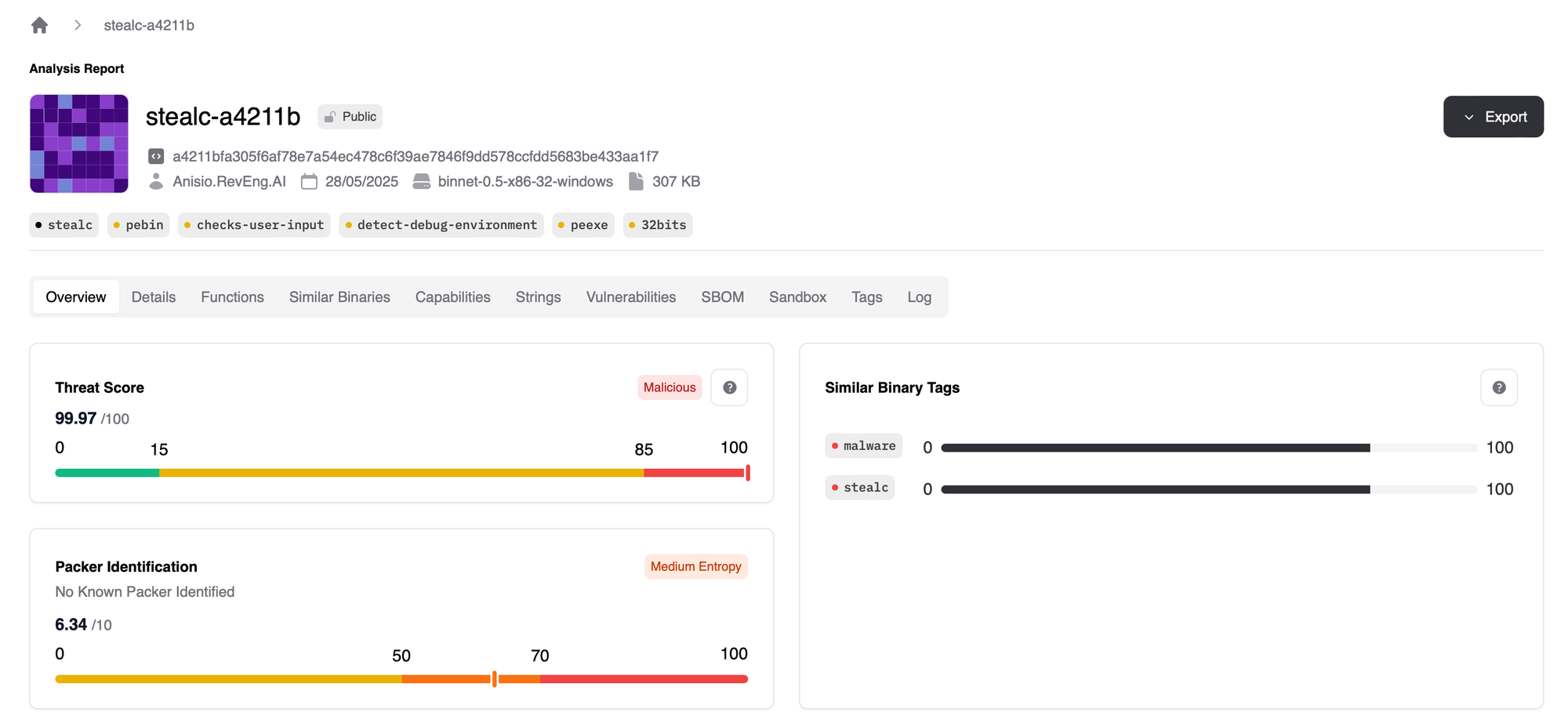
Alternatively, RevEng.AI users can detect StealC variants based on a BinNet AI summary of the sample. This looks at the intent and behaviour of code contained in the malware and finds similar samples uploaded to the platform. For example, the StealC binary referenced in this blog post is most similar to the following files: